Category Archives: Uncategorized

Saudi Women’s Man-o-meter

 When the issue of the ban on women driving in Saudi Arabia comes up it sometimes leads outsiders to question the contradiction between gender segregation and a woman spending so much time alone in a car with an unrelated man. To completely understand how this came about you have to go back in history to when slavery was the norm. Back then, women did not stringently cover from their male slaves and in some families they did not cover at all. The neutering of some male slaves was socially acceptable. This attitude somehow transferred to the modern day drivers. Women who are religious strictly cover from their drivers but the majority treat drivers like a little less than a man.

Another aspect that plays into this contradiction is the driver’s nationality. As a writer, I do not mean to offend anyone but this is an unspoken fact that I have observed as part of this society. The main point of covering up besides just obeying Allah is to discourage unwonted attention and to nip any idea of a romantic relationship. On that latter point’s basis, the driver’s nationality eases the restriction on interaction and covering because a relationship is completely out of the question. This is true for any nationality east of the Middle East. And it is also true for waiters, cleaners and cooks. I have sat at restaurants with women who cover at all times  but once the table partition is put up they take off all their head covering because the waiter is an Indian, or Pilipino.

The mostly manliest men that women will go running behind a curtain if they don’t have a abaya nearby, are men within the same age range and come from the same region and tribe. If they are too young  or too old she’ll probably just hold a sofa cushion in front of her face until a child or maid hands her her abaya.  So when Qassimi women come to Riyadh, they won’t be so strict about their abayas and scarves at the mall because there is less of a chance of them running into a male cousin, neighbor or family friend. And women from Riyadh are known to relatively go wild when visiting the Eastern or Western Region based on that same principle. A Husband pays little attention to his wife’s abaya after they leave the house. But if he happens to see a colleague or cousin coming his way, trust that he will quickly scrutinize his wife’s attire and if it is the least bit revealing he will distance himself.  And this is also why a Saudi female customer will interact differently with a Saudi shop assistant  based on his regional accent.

At the next level you have Saudis in general. This is observable abroad. Saudis will mingle with the general population of their host countries without worry about proper hijab. This will remain the state if only a few other Saudi families are within the bumping into each other zone. Once the number of families grows into the double digits, even the most liberal women will consider covering up.

Other male Arabs and Westerners with the exception of Egyptians are almost looked at as gay. Because many Saudi women have come to believe that these men, unlike their Saudi counterparts, unquestionably respect women. Saudi women cover in their presence. However they are a lot more relaxed in conversation and body language.

Unfortunately, Egyptian men here have not been able to cultivate the above reputation. I don’t know if this is because of the bad impression people get from Egyptian movies or because of the conduct of a few bad apples.

4 Comments

Filed under Uncategorized

Line 120 or 220 volts?

The Iraqi war really brought the spotlight on the Shia -Sunni struggle within  the region, when before, outside of the Middle East, there was no distinction between Muslims. Little be known to the rest of the world there are other  layers of discrimination in the region.  Two of which affect a Saudi’s marriage and job prospects. The first and most important is whether a person belongs to a tribe or not. You are 220 if you belong to a tribe and 120 if you don’t. There are many tribes in the region and tracking and documenting them is a centuries old science that is still very much alive today. I’ve also heard stories of specialists who were able to track which tribe a person belongs to just by looking at their facial features. Though I don’t believe they exist anymore. The most prestigious tribe to belong to is the Ashraff. People who are even remotely related to this tribe will drag out their family tree at every opportunity. And they are understandably the most prestigious because they are descendents of the Prophet Mohammed’s (PBUH) family. Now most claims to this tribe are bogus but the few true lines of heritance are carefully documented in books. The most famous Asharaff family today is the Jordanian royal family. But personally I think they have diluted their blood with too many British and American commoners.

Then there are Saudis who don’t belong to a tribe. The first of two main reasons why is that they go back to an ancestor who has been disowned by his tribe for committing a crime or taking up a manual job. These families are easy to identify because their last name usually means in Arabic some kind of job like blacksmith or baker. The other main reason is that the family goes back to an ancestor who immigrated here. These families usually have a last name that in Arabic means some kind of nationality like Egyptian, Morroccan…etc.  The only exception I know of to the latter reason is the Hindi family who are tribal.

Another layer of distinction is made up of Bedouin or urban. Bedouins are families who only in the past century have settled down. Before they used to roam the desert never belonging to any particular region. Urban are families who belong to tribes that have always lived in towns and cities, only occasionally moving.

Part of a Saudi’s life is to be classified as one of the following:

a) Urban and tribal: These Saudis are the most stuck-up, refined and know how to spend money.

b) Bedouin and tribal: These Saudi are not as sophisticated but are more generous and their women are given a lot more freedom and respect.

c) Urban and nontribal: These Saudis are concentrated in the Western region and they mostly come from ancestors who were originally overstayers after performing Hajj.

d) Salab: These Saudis come from gypsy ancestors.

How does this matter in day to day life? Within their circles, both Bedouins and tribal Urban consider being called the other an insult. Urban mothers tell their children not to be Bedouin when they, for instance, attempt to leave the house in their pajamas.  And Bedouin mothers tell their children not to be urban when they get scared of a spider. To urban families, being called Bedouin has connotations of being unrefined and unruly. And in Bedouin families, being called an urban essentially means sissy.

And until recently, the Saudi nationality had been withheld from many salabs. Even though they have been on Saudi land for more than a century.

When it comes to job-hunting, let me just say that if you take a close look at any Saudi establishment, you’ll find that strangely a great number of the employees belong to the same tribe as the head of the establishment.

In marriage, it doesn’t matter much if you are Bedouin or urban. What matters is whether or not you’re tribal. If a Saudi is tribal and marries someone who isn’t, the father of the tribal spouse is expected to disown them. And the whole marriage has long term negative effects. The siblings of the tribal spouse will be limited in their choice of life-partners. A famous case that originated in such a mixed marriage is that of Fatima who after having two children with her husband, was forcefully divorced by her half brothers after her father passed away. Shockingly the divorce was sanctioned by the Saudi judicial system.

Fatima Starts Hunger Strike Despite HRC’s Reunion Assurances
Ebtihal Mubarak, Arab News

JEDDAH, 25 March 2008 – A Saudi woman, who was forcibly divorced from her husband by a court in 2005 at the request of her half brothers, yesterday began the first day of a hunger strike despite officials saying that the couple would soon be reunited.

“I won’t believe it till I see it… I’ll remain stuck in this shelter like an outcaste. Everyone asks me to be patient and wait,” said the woman known as Fatima.

One of my own relatives fell in love with a person who belonged to a non-tribal family. Just when they were about to announce their engagement, my great uncle threatened the father with disowning his whole family. So everything was broken off before it got too serious. This of course is extremely un-Islamic and a great example of how our society is truly ruled by custom and culture rather than religion.

38 Comments

Filed under Uncategorized

Prominent Saudis: Sheikh Mohammed Al Arefe

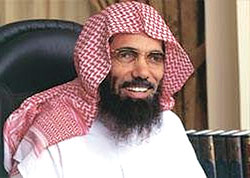
Mohammed Al Arefe is the complete package. He is the Brad Pitt of Sheikhdom. Unfortunately he truly puts women in the toilet when it comes to their rights and humanity. His ideology is the typical close-minded outlook that Saudi society has grown accustomed to from its religious leaders, except when it comes to this particular religious leader, it almost seems like he has hypnotic super-powers. Even women will accept being told that they are less than men when it comes from his mouth. He is very charismatic. And I believe it comes across even with language barriers. This is a short video of him telling a funny story about his seven year old daughter learning her daily prayers.

Rough Translation: In the video he says that he is trying to encourage his daughter Jumana to pray. So one day he told her to pray the thahir (noon) prayer, she with resignation said ok. On his way back from performing Asir (afternoon) prayer at the mosque, Jumana opened the door for him and he asked her if she had prayed that prayer. She replied oohhh not again. Do I have to? But she goes and does it anyway. Then on his way back from the next prayer, the Maghreb (sunset) prayer, she again opened the door for him and immediately laughingly says OOhhhh you’re killing me with all this pray pray pray …

Some of the issues that he has raised was his objection at the first National Forum to the women who drove in 1991. That they should not have been allowed to resume work and influence other women, especially the participants who also happen to have teaching posts at schools and colleges.  He also proposed that a rule or law be established so that liberal women would not be able to take advantage of their jobs as teachers and lecturers to spread their sinful ideas. And that those teachers would be strictly instructed to teach what is in the books and not their opinions and views.

He is also extremely well-travelled. He hops from one country to the next giving lectures at mosques and even has debate type of sittings with priests and leaders of other religions. I attended one of his lectures at a mosque in Birmingham, UK. Of course he sat in the men’s section and women could only hear the lecture on the sound system. In the lecture he spoke about how to deal with teenagers that are raised in the west and have been westernized. Throughout the lecture he completely ignored women. He gave advice only to fathers and spoke only about problems with sons. As though mothers had no say or effect and there was no fear about daughters being westernized.

Here’s another video of him speaking on how to beat your wife. It already has English subtitles.

If only whatever changed Sheikh Salman Al Ouda would change Sheikh Mohammed Al Arefe it would probably be the last straw that breaks our ultra conservative camel’s back. With his huge following here in the central region, he is a man with a lot of power to either keep us on our crazy path or get us to see the light.

59 Comments

Filed under Uncategorized

Saudi Women and Their Drivers

In Saudi Arabia you can tell a lot about a woman by her relationship with her driver. Yes I call it a relationship. Because, unlike anywhere in the world, drivers are a necessity and not a luxury that is used on a whim. A driver here knows his employer’s (or charge, depending on how conservative the family is) every single habit. Is she punctual or late? How social she is and who calls her and whom does she call. And depending on the size of the car, he probably even knows the smell of her morning breath. Her moods, shopping habits and favorite drink are common knowledge to not only her own driver but also to the neighbors’ drivers. Just as an example of how suffocatingly close a driver is, when my husband cannot reach me on my cell phone, he contacts the driver because wherever I am, the driver will of course be there too.

With someone that close, a relationship has to evolve. For some of my friends, it is a nurturing relationship. Just as long ago when people had horses and at stops the first thing they would do is make sure that the horse is put in a stable and provided with nourishment, these friends first make sure that the driver is let in to wait in the little cramped host’s driver room. Some even go as far as to prepare at home before going out tea in a thermos and some snacks for the driver to enjoy while he waits. When I ask them why go to all that trouble? They tell me that they cannot afford another runaway so they’re trying to make the job as pleasurable and easy as possible.

Others have a more master- slave relationship. They scream at their drivers. I’ve personally witnessed a woman hit her driver when he made a wrong turn. And if you try to comment they’ll say he should thank God that I’m willing to give him a job. Ironically, these women always end up with the loyal drivers who stick around for years. The driver that I witnessed being hit stayed with that employer for over 14 years.

And then there are the delusional, who try to ignore the presence of another human being in the car as much as they can. They gab on their phones and get in and out of the car just barely informing the driver of the destination. When they get there, they leave the car with no instructions as though the driver is just another auto part that will be there with the rest of the car when they finish their errand or visit.

No matter what type of relationship it is, the bottom line is pure unadulterated frustration. Why do we have to put up with this? Why do we have to fork out salaries and accommodations? Why do we have to figure out if we should let the driver wait outside or cruise around Riyadh on our gas money every time we reach a destination?

18 Comments

Filed under Uncategorized

Ramadan

Ramadan is month when everyone fasts from sun rise to sundown. We fast from food, water and sex. This deprivation is supposed to make Muslims stop and think about those less fortunate and life in general. Muslims are also supposed to focus on their religious and spiritual wellbeing throughout the month. I cannot deny that it does work for many Muslims, but there are others that have turned it to a commercial holiday. Starting a week before Ramadan, people start congratulating each other on seeing another Ramadan. And there’s a whole lot of shopping and preparation that goes into it. Special Ramadan recipes are dug out and Ramadan themed social events are set up. It can be really fun for people with time-off from work. But people like yours truly and millions of other Saudis still have to go to work and that is tough on an Islamic vampire day schedule.

During Ramadan everything is turned upside down. Government offices are open for only six hours. Everything slows down from the already slow pace it usually moves at. Except of course the traffic. It gets really crazy. Sleep and caffeine deprived drivers in the morning and starving and dehydrated drivers in the afternoon do not make safe roads. I know nothing about the statistics but I bet that car accident numbers increase in Ramadan.

What I especially love about Ramadan is its effect on the younger generation. They get one degree more religious then  they usually are the rest of the year. If you have a teenager or young adult who listens to music, chats, misses a prayer now and then and has a cell phone significant other, during Ramadan they’ll stop listening to music, pray more carefully and ditch the phone buddy. Chat however will resume after a 24 hour attempt at stopping. And MTV Arabia has tapped into this annual trend. That is why it is not broadcasting any music videos for the whole month! Instead they show programs like Cribs and reality shows. This decision has really won hearts here.

Also around Ramadan you get public message type of commercials that are really well produced. They are about being a good Muslim. The first one I remember was about how the five prayers  are your stress free sanctuary during the day. The latest is about a young man who gets an urgent call while apparently fasting during Ramadan. He breaks his fast eating a banana while rushing in his car to the hospital. When he gets there it turns out he was needed for an emergency blood transfusion. And the teary eyed mother of the patient who needed the blood  thanks the young man profusely. So he was actually doing his duty. I wonder who’s paying for them. When the first one was broadcast there were a lot of rumors that a prominent direct grandson of the founder of Saudi Arabia was, but I have not come across anything official confirming that.

One thing that Ramadan is really about is free food. And the poorer you are the fatter you get. Mosques, charities and even individuals fall over each other setting up tents with tons of free hot and cold meals for anyone who’ll show up, Muslim or not. The majority of people who frequent these tents in Ramadan are expatriate manual laborers and drivers. As well as half an hour before sunset, at all the main stoplights you’ll find volunteers passing out little snack boxes to break the fast with.  People offer free food during Ramadan because in Islam it says that when a Muslim breaks his fast on your food then that Muslim’s fast counts as both your own and his. Its kind of like getting extra points.

The last thing I’m going mention about Ramadan is the Taraweeh prayer. This prayer is performed en masse only during Ramadan. It is right after the last prayer of the day (Isha) and it’s about three to four times longer than usual prayers. To get the best experience you are supposed to pick a favourite mosque and stick with it from the night before the 1st of Ramadan until the night before the last of Ramadan. That way you’ll have covered the whole Quran. Taraweeh, by the way, is the only prayer that women are encouraged to attend in the mosque rather than pray at home.

1 Comment

Filed under Uncategorized

My Favourite Professor

As a tribute to a woman who has influenced so many Saudi women over the approximately two decades she has lived here, I have created a page to honour Prof Angele Tadros. I first got to know her as my head of department when I was a teaching assistant in 2003. And now although I no longer work in her department, we still share a friendship that I truly cherish. She is the closest thing to a role model in my life.

2 Comments

Filed under Uncategorized

What does being Wahabi mean?

According to the outside world and media, it is a form or sect of Islam that goes back to  Sheikh Mohamed bin Abdulawahab. But to Saudis, especially the central region it is a sub-tribe of the Tameem tribe which coincidentally Sheikh Mohamed and I both belong to.

To set the record straight, no Saudi calls himself Wahbi unless they belong to the sub-tribe I mentioned above. To us Sheikh Mohamed was just another famous big sheikh who also happened to be into politics. He did not start a new Islamic sect. What he did do was educate people in the central region. The central region is practically an out of the way desert. Sheikh Mohamed was born here in Al Uyyanah, not far from Riyadh. He travelled to Makkah, Medina and Iraq to study Islam and then he came back and taught his people. At that time, people here were illiterate, superstitious and many had forgotten or never learned the basics of Islam. There are even stories about paganism and idol worshipping. So he came back to teach people. And he also made a pact with an ancestor of Al Saud, that he would take care of the religion and Al Saud would take care of bringing unity and government to our people.

Sheikh Mohamed, contrary to popular western belief, was not an ultra conservative hell bent against women and human rights. He barely delved into these issues. He had religiously bigger issues to take care of with wiping out paganism and the worship of saints and reeducating people on how to pray! He was also busy stifling the spread of Shiaism. His main focus was to resume the monotheism condition of Islam. He did such a great job that  by the time he was through, the region had all the basics of Sunni Islam down. So much so that for the next two centuries, many many so-called sheikhs sadly had nothing better to do but twiddle their thumbs and create petty fatwas. For example, one that I came across written in the late eighties, early nineties that women should be discouraged from watching soccer matches on TV because the excitement of seeing men in shorts running around is too much for her fragile emotional health. That was a FATWA!

I digress, back to the term Wahabi. This is definitely an outsider’s term. And to those who the term refers to, it is meaningless. It isn’t even derogatory. It has no meaning outside of lineage and tribal names. There is no Islamic sect called Wahabi and Sheikh Mohamed bin Abdulawahab did not create a new Islamic perspective. He was just a famous and notable figure in Saudi Arabian history.

So what Islamic sect does the central region and the government follow? It is Sunni and we strictly follow Sheikh Ahmed bin Hanbil and Ibn Taiymiah, both of whom came long before Mohamed bin Abdulwahab. Religiously speaking we call our selves Hanabillah. The next time you hear someone say “those crazy Wahabis” please correct them and say “they’re actually crazy Hanabillahs”.

379 Comments

Filed under Uncategorized

Saudi Salons

They are called Mashghal  in Arabic which literally means a working place, from the Arabic noun shoogal (work in general). This term was coined to refer to little shops where a group of usually Pakistani tailors make women dresses. About 30 years ago readymade women clothes were mostly unavailable to the general public and women drew designs on paper and took then to these tailor shops with fabric bought by the meter from areas similar to outdoor malls. For measurement, they would give the tailor a previously made dress that fits and he would use it as a measurement model. And that’s to avoid any physical contact between the tailor and the customer. I know now you’re wondering where did women get there first well measured dress and I too wonder.  

These little tailor shops started to evolve into closed women shops where the tailors are women from the Philippines. The shops became bigger and the décor  slightly better. However these women only shops are pricier, so the male version stuck around. The women mashghal started to quickly expand into the beauty salon business. So a women could go get her hair done and have a dress made at the same time. But when Al Eissaee, a big name in the fabric import business, started  to also bring in quality readymade clothes, he started a huge trend that snowballed into our current mega malls. This in turn affected the tailor business for both the male and female shops. The male mostly went out of business except for a lucky few and the female shops concentrated more on the beauty salon side of the business, so much so that some even closed the dress making side. But for some unexplainable reason they are still called a mashghal  even on official ministry of commerce licensing papers.

4 Comments

Filed under Uncategorized

Prominent Saudis: Sheikh Salman Al Ouda

 Sheikh Salman Al Ouda was born and raised in the city of Buraida in the Qaseem region north of Riyadh. He holds a PhD in Suna the prophet Muhammed’s (PBUH) sayings and actions.

The sheikh is really two persons in one; there’s the sheikh pre-prison and the sheikh post-prison. The pre-prison was basically a bin Othaimeen clone, same mentality and type of fatwas. And that’s not a surprise considering that he studied under him. He instructed followers to go to Afghanistan and Jihad in its most violent versions. A Youtube video has a copy of one of his audio lectures where he tells listeners that the only real way to spread Islam is through violence. He pretty much stuck to the norm for ultra conservative Qaseemi sheikhs. Then he deviated into Saudi politics and economy and that’s when he ended up in prison for five years starting in 1994.

Sheikh Salman came out of prison a changed man. You would think he spent his sentence in a western culture. His whole ideology took a 180 degree turn. Now he reminds me more of an Egyptian Azhar sheikh rather than one from Qaseem. My sister saw him in a mall in Dubai with his wife and kids. The real shocker is that his wife was wearing a niqab and her abaya was on her shoulders and NOT tent style over her head! That’s the Saudi equivalent of seeing a priest’s wife sunbathing topless.

That is nothing compared to the fatwas that he has come out with like discouraging Muslims from violent jihad and most recently he said on his show on the MBC network that it is alright to celebrate  personal holidays like birthdays and anniversaries just as long as you don’t call them “Eid”.  Now this is a biggie here. A sign of a true muttawa is that they only celebrate the two religious holidays and nothing else, not even the Saudi national day or the beginning of a new Hijri year. Last December, I threw my son a big party for his sixth birthday and all my in-laws boycotted it because they say it is Islamically prohibited. And that is typical for muttawas, so when sheikh Salman challenged that, there was a huge backlash in newspapers, on websites and even on Youtube. There you’ll find a video titled in Arabic the idiocy of Sheikh Salman Al Ouda in which they show him giving fatwas pre-prison and then giving recent fatwas that contradict his old ones. In many ways this has discredited him as a sheikh for the central region’s ultra conservatives. It also took him out of the running as a contender for the position Sheikh bin Othaimeen left vacant since he passed away. This just shows that Saudi Sheikhs are not allowed to change their minds no matter how long their career span might be.

18 Comments

Filed under Uncategorized

My little dilemma

I’ve lived in the US as a child, pre 9/11 in Kansas. And in such a “redneck” part of the country, my family and I were subjected to some racial incidents, the most memorable of which is a man spitting on my father’s BMW after finding out the owner was Arab. Another that really sticks out is one time I was doing my business in a bathroom stall and I called something out in Arabic to my sister.  So the lady in the stall next to me stood on the toilet, grabbed me by the hair and started screaming insults at me. I was only about 10 at the time.  Her boyfriend or whatever had to rush in and pry her away. It turns out she had one too many beers and blamed me for her brother’s death in Lebanon. I also remember my art teacher at school who had to have other teachers come in and convince her to treat me like a human being in conversations that were within my earshot. I guess they thought I was too young to understand.  Or my mother at a convenience store being harassed by two farmer looking guys for speaking in Arabic. All of this before 9/11, so logically it must be worse now.

It wasn’t all bad or otherwise we would have left before my father finished his studies. The US is fantastic both for study and tourism. The way I see it, it’s a win-win situation. We get the benefits of the great higher education system and have fun at tourist sights and go back home at the end of the day. We pay our way throughout. And I have never known a Saudi to immigrate to a western country. And yet you still get these little incidents. It’s as if every Saudi is a member of the higher royal family or maybe some Americans think that we are secretly a democracy and all Saudis have a voice in their country’s policies.

Anyway my little dilemma is that I am currently in the US and I have my kids in tow too. Naturally we sometimes get the “where are you from” question from people like store clerks or park bench neighbors. So far, I’ve answered truthfully. But I am considering teaching my kids to say something like Turkey, although I hate the thought of oking lying. Maybe, I’ll just stick to the truth.

10 Comments

Filed under Uncategorized