Isn’t it about time for a draft law to protect children from abuse?

Prof. Fawziah Al Bakr has had a long history in human rights activism. She is a professor of education at King Saud University. She is also a writer who spent three months in prison for her columns. You can read a translation of her article on gender apartheid here and you can follow her on Twitter here.

This is a translation of an article  written by Prof. Al Bakr published in Al Jazirah newspaper today.

It is no longer easy to read our local newspapers, now full of painful news, especially related to children, young orphans and disadvantaged minors and women. These are those most vulnerable in a society that tends to substantiate male superiority while perpetuating the weakness and subordination of women and children.
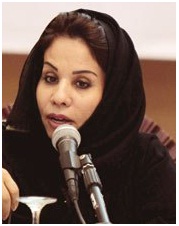
Prof. Fowzia Al BakrThe story of the little girl Lama that was sexually abused and murdered by her father, who is now in prison awaiting trial, and other recurrent stories like it, show the power of men in this society and their capability of harming weaker parties unable to defend themselves due to lack of awareness, mechanisms and laws that protect children and women from all kinds of harassment and abuse.

Societies are based on families caring for their children. A father and mother’s immediate responsibility in every family is to care for and nurture their children, but that is not what occurs in all cases. In Saudi Arabia, there is a need to form laws that protect weaker entities within the institution of the family. The absence of such laws produce cases like Lama, who die waiting for justice, and this absence of legislation will keep producing others like Lama we may or may not know about.

In the past, it was acceptable and feasible to address similar cases within the context of the family and neighborhood due to the small population of Saudi at that time and the simplicity of the social system. This is no longer possible in this day and age. The population of Saudi has grown enormously and every family within this modern lifestyle system has practically barricaded themselves inside their cement homes, isolated from others around them. Many negative lifestyle options have now become accessible such as drug use and alcohol while the legal system has not caught up by implementing legislation, protocol and social services to prevent and protect against abuse and neglect.

Our modern times have seen a shift in how we define and view terms like childhood, abuse, neglect and other terms relating to rights in modern social institutions. Our generation was subjected to many forms of verbal and (maybe physical) abuse from teachers, parents, relatives and neighbors according to the prevailing intellectual structure of the society; as the Arabic proverb goes the meat is for the teacher and the bones for the parents. If at that time society did not criminalize many forms of abuse, today there is no room for such practices, even if it is for noble goals. No one can hit a child under the pretext of disciplining or slap a teenager under the pretext of returning him or her to their senses, let alone deliver deliberate harm or neglect or sexual abuse as poor Lama faced that left her body lying in the morgue for four months!!

It is time to wake up. Such practices must be criminalized because it is a crime in our modern time’s definition. Many of the frighteningly light court rulings on cases of domestic abuse do not correspond to the severity of the crime. Civil and Shariah laws should be updated to catch up with Saudi society’s intellectual shift in the understanding of rights and duties. All kinds of abusive behavior against children and women should be clearly identified by law makers and Sharia laws and codified.

There is an immediate need to call for a draft law that clearly defines all forms of abuse including verbal, psychological, physical, and sexual abuse and other forms of sexual harassment and abuse that women and other minorities in society face.

We have grown weary of hearing about the Lamas of our society. Their stories, reverberated by the newspapers and satellite channels, nationally and internationally, have created an awareness among society regarding the lack of a basic law for the protection against abuse. It is high time for legislation to cover this deficiency. Saudi Arabia has signed many international treaties that ensure basic human rights for all and rejects any kind of discrimination. Islamic laws also emphasize the protection of rights for all. Our shared religion and these treaties could help us to initiate laws against neglect and abuse that many have long waited for.

16 Comments

Filed under Uncategorized

More on Lama

I’ve written about Lama’s horrific case in the last two posts and about the response from the justice ministry and local official human rights organizations. So here’s an update and more information in other formats.

BBC WHYS radio program invited two veteran human rights activists, Aziza Al Yousef and Hatoon Al Fassi to shed light on the case and clarify the assumptions and ambiguities surrounding the Saudi legal (system?). I highly recommend listening to this and compare it to the official government statement. To listen to the recording CLICK HERE.

If you are short on time watch the CNN 3 minute video report, which will bring you up to speed and also has brief input from Aziza Al Yousef. To watch CLICK HERE.

9 Comments

Filed under Uncategorized

What’s up with the National Society of Human Rights?

Is it strange to believe that a human rights organization would prioritize human rights? In the case of the five year old Lama who was tortured to death by her father, the NSHR seem to want to downplay both the crime and the judicial rulings. On the one hand, we have Itimad Al Sonaidi, an NSHR legal investigator, stating to the newspapers that there is no truth to the news reports that blood money had been offered. And on the other hand we have Khalid Al Fakhri, NSHR general director, denying that Lama had been sexually assaulted. Even Suhaila Zain Alabdeen, before strongly speaking out on the case and giving details was careful to have it made clear that she was on the news program as an activist and not as a member of the NSHR.

First, when it comes to whether or not Fayhan Al Ghamdi had raped his daughter, the social worker assigned to the case, Randa Al Kaleeb stated so in a phone interview with an investigative program host, Ali Al Olayani. And we have Dr. Mohammed Mahdi, the medical examiner in Lama’s case,  from the Forensic Medicine Department in Riyadh, who stated to Asharq Aawsat:

The offender committed all types of physical abuse on the victim as well as her exposure to sexual assault as a result of swelling in the region of the genitals and laceration in the anal area. There is ambiguity and secrets and the narrative is incomplete. In domestic abuse cases, injuries are usually afflicted over several months and not all in one bout. Also there is disparity in the type of injuries, from burns to those afflicted with sharp tools, along with the presence of strikes that take distinctive forms. All of these specifications have been identified on Lama’s body through the bruises and effects of burns and blows and led to them being afflicted with a thick electrical cable and a cane. These tools have been seized from the offenders home at the request of the Forensic Medicine Department as evidence. It’s Lama’s right that we reveal the truth of what happened to her.

Second, when blood money is offered and accepted then all maximum penalties are off the table. Over and over again, the courts have let fathers and husbands literally get away with murder by paying blood money and at most serving five to twelve years. I’ve given examples in my previous post, but I’ll give you another example that’s as recent as January 6th 2013. Wissam was a 13 year old to an Egyptian mother and a Saudi father. His mother came to Saudi as a 16 year old bride twenty years ago. Five years ago her husband divorced her and the torment began. It ended with the father chasing Wissam from the street to the door and stabbing him over and over again. Wissam died minutes later in his mother’s arms at the entrance of his home. The final ruling on January 6th was that blood money be paid and a five year sentence. After the judge ruled, Wissam’s sister turned to her mother and asked “Mama when father comes out of prison, will he kill us like he killed Wissam?”

Dr. Amal Al Kafrawi psychiatric and addiction specialist told Alwatan that protection from domestic violence committees under the Ministry of Health are unavailable and non-existent, despite the existence of them in name within the ministry. She added that the impact of domestic violence is mostly suffered by the children. She stated that we find that the weak individual is assaulted in every way without having the chance to defend himself or his human rights, which must be guaranteed by his community, so children grow up in an atmosphere of constant persecution and humiliation that destroy their innocence.

The only case in Saudi history when a father/murder was made to pay is that of Ghusoon, an eight year old girl who was chained and tortured over a year by her father and stepmother while her mother ran from one official to the next asking for help. Ghussoon was starved, had kerosene poured over her, burned and even hit with a car in her father’s yard. All of this because the father doubted his paternity. Alas Ghusoon died before anyone would listen to her mother. In only that case was it considered murder and the father executed. You would think that Ghusoon’s case would create a precedent, right? Wrong. Because Saudi’s (reminiscently medieval) justice system is resistant to codification. Every judge can rule in whatever way he sees fit, as long as he can find a religious text to base his ruling on. That means you can have two cases of murder, divorce or whatever with the exact same specifications and in the courtroom of the same judge and still get two different rulings depending on who the defendants are, what they wore, their piety…etc.

I can only guess what the motive is behind NSHR statements and actions. The only thing that’s apparent is that they are downplaying the case.

24 Comments

Filed under Uncategorized

Rest In Peace Lama

Lama was a five-year-old half Egyptian, half Saudi girl. Her mother was born in Egypt and immigrated to Saudi over 25 years ago. Her father, sheikh Fayhan Al Ghamdi, was a frequent guest speaker on Islamists channels. Al Ghamdi divorced Lama’s mother and took custody of Lama soon afterwards. In this video he tears up at the plight of orphans as he talks about the religious rewards of adoption.

Image

According to news reports, Al Ghamdi told the judge that Lama was behaving strangely and that he questioned her virginity. He went as far as to have a medical professional check that her virginity was intact. Her mother said in an interview on Ali Al Olayani’s show that she felt that there was something wrong three months before Lama was admitted to the hospital but that her ex-husband would only allow her short telephone conversations. She begged him to give her the girl but he refused. By the time she finally got to see her, Lama was in the ICU. Her mother described her to Al Olayani; Lama had one of her fingernails removed, the side of her head was smashed and the rest of her body was covered up. She had to hear from hospital staff and social workers how Lama’s rectum was torn open and that the abuser had attempted to burn it closed. Randa Al Kaleeb, a social worker from the hospital where Lama was, told Al Olayani in a phone interview that Lama’s back was broken as well and that she had been raped “everywhere”.

Image

It’s a horror story on all levels. Yet the horror did not end with Lama’s death last October, as the court has initially decided that the four months that the father/murderer spent in prison is enough time and that all he has to do is pay blood money. Four months and a few thousand riyals is the cost of Lama’s innocence and life. This outcome is based on a hadith that does not occur in the two top resources for hadith, Bukhari and Muslim. It also goes against the Quran’s condemnation of fathers who murder their daughters. The hadith translates into “A father is not executed for his child.” Of course the patriarchal misogynistic scholars and judges who use this hadith to justify not punishing Al Ghamdi, do not care about the long-term implications of such a ruling. According to Suhalia Zainalabdeen, a member of the National Society for Human Rights, in all of her career she knows of only one case in which a father was severely punished for torturing and killing his daughter. She says that this leniency is also extended to those who murder their wives. She gives two examples of similar cases. One in which a husband cut his wife’s throat as she was breastfeeding their child and he only got five years for it. Another is the case of a husband who tied his wife to his car and dragged her until she died. He got twelve years.

If that’s what murdering male guardians get, can you imagine the leniency when those they abuse don’t die? Male guardians are legally able to sell their daughters as child brides. There are no laws that protect children, especially girls. When a child protection system was proposed to the Shura council, they got stuck on how to define childhood without banning child marriages. Stories of mothers who cannot get custody or protect their daughters from abusive fathers abound. I personally spoke with a social worker that has twelve years experience in the system. She told me that what usually happens is that the abused woman would go to the police. The police would then call the Commission for the Promotion of Virtue and Prevention of Vice (CPVPV) and the woman’s male guardian who is in most cases her abuser. So there would be the woman surrounded by policemen, clerics and her abuser. The aim is to “reconcile” the woman and her guardian. The social worker told me that the police and clerics would keep trying at the reconciliation for up to four hours. If the woman refuses to leave the station with her guardian, only then would social workers be called and protection offered.

There are no reports that I know of where abusers were sentenced for abusing their daughters and/or wives. The worst they get is a short detainment for questioning and in the worst cases they are required to sign a pledge to not do it again.

Apologists and extremists perpetuate that the male guardianship system turns women to queens. That might be true but only in a macabre sense of the word.

309 Comments

Filed under Uncategorized

Karen Elliott House’s On Saudi Arabia

On Saudi Arabia House

I finished reading House’s book On Saudi about two weeks ago and I’ve had quite a few people ask me what I thought about it. I tell them generally what I thought which is that it struck me as a book where it seems that in an overenthusiastic frenzy to be bold, she didn’t have much regard for accuracy. The whole book does not strike me as a book written by a person who has been visiting Saudi for five years, at least not a very observant one. The whole style is not far from what you would get from a book on Saudi published in the 1960s purely for an American audience unlikely to question it or have access to interaction with a Saudi.

When I say this in a conversation, the only examples that come to mind is her equating the Kaaba with the Holy Stone on page 31 and her claiming that a very questionable Hadith is “popular” to bolster her argument that Saudis are submissive to the monarchy as part of their practice of religion. The hadith she claims “quotes the prophet Muhammad urging believers to “stick to obedience even if it is to an Abyssian slave, since the believer is like a submissive camel, wherever he is led, he follows.””  And the source is some obscure webpage.

Yet it’s not only those two samples; the book is riddled with many inaccuracies that niggled at me as I read. Right now, sitting at home with the E-book, I’m better equipped to elaborate with a few more examples:

House wrongly states “Unlike the other schools of law, which employ consensus (ijma), analogy (qiyas), and other rationalist methods to decipher God’s will, the Hanbali tradition relies almost exclusively on a literal interpretation of the Kuran and Sunna for guidance.” Page 37

Needless to say, the Hanbali tradition is strongly based on ijma and qiyas. For example qiyas and ijma is why women can’t drive in Saudi because anyone with the most basic background in Islam knows that there were no cars at the time of the Prophet and women were able to ride horses, camels and donkeys. Thus there is no “literal interpretation” that would lead to the Saudi fatwas banning women from driving. These fatwas and religious arguments were all based on Saudi clergy consensus and analogy.

Another example of House’s inaccuracies is her repeatedly quoting Robert Baer as an expert on Saudi and it’s oil fields. A man who has never visited Saudi and is notorious for his conspiratorial demonization of the Saudi government. His book’s titled Sleeping with the Devil, the devil being us Saudis; not exactly what one would call optimal journalistic objectivity.

And then of course there’s House referring to Hail as a region on the Saudi-Iraqi border, which of course is simply disproven by checking any map. Hail is part of the central region and quite a ways from any border.

And then there’s a sentence I particularly enjoyed on page 208: “Three school gymnasiums host Catholic, Protestant and Mormon services, not only for Saudi ARAMCO employees but also for Christian expatriates in the surrounding area.” I know ARAMCO is relatively open compared to the rest of Saudi, but Saudi employees practicing Christianity openly on premises is beyond ludicrous.

And the list goes on and on from exaggerating the Iranian threat to inaccurate statements on education. Yet the most crucial issue that House got wrong is her understanding of Saudi mindsets and particularly Saudi youth. She almost made it out to seem that we are somehow inherently passive and too arrogant to work.

“Saudi Arabia, in short, is a society in which all too many men do not want to work at jobs for which they are qualified; in which women by and large aren’t allowed to work; and in which, as a result, most of the work is done by foreigners-Pakistanis, Indians, Filipinos, Bangladeshis, and others-who compose the majority of the labor force.” p. 147

Nowhere does she mention how difficult it is to compete in a market where foreign labor is cheap and desperate. How is a Saudi supposed to compete with someone who is willing to work twice as long and for a quarter of what a Saudi needs to live and cover basic needs. For example, in nursing, a Filipino or Indian is happy to work insane hours for anywhere in between 2,500-4,000 SAR (670-1000USD) and live in a dorm-like situation nearby. How are Saudis supposed to compete with that?

Then House goes on to assume she understands what Saudis want for their political future:

“So America conceivably could influence the kingdom, but in no way is the United States the role model for Saudi Arabia. Increasingly educated Saudis want to modernize, but they most surely do not want to Westernize, and they resent the American view that modernization means Westernization. Saudis don’t pine for democracy, but they seek a more open civil society where they are free to congregate and express views and where society’s rules are clear and enforced equitably on all. They want Ipads and access to the Internet, but the conservative among them-and most Saudis still are conservative- do not want all the other alien infidel influences emanating from America and the West. Saudis are unique and seek to remain so.” P.236

House’s summation of what Saudis want is so superficial that I literally cringed when I read it. Seriously is this what she got from visiting Saudi for five years? Ipads and infidels! I guess a lot was lost in translation. The only thing she got right is that Saudis are not looking to an American model for their future.  What most agree on, across liberal and Islamist factions, is more like a Norwegian model; a constitutional monarchy with an elected PM and parliament and a welfare system that reflects how rich the country is. Was she not aware of the thousands who signed petitions demanding a constitutional monarchy in 2011? One that got 6100 signatures in a week translates to the following:

  The People want to Reform the Government Campaign

To support the right of the Saudi people and their legitimate aspirations:

1 – a constitutional monarchy between the king and government.

2 – a written constitution approved by the people in which governing powers will be determined.

3 – transparency, accountability in fighting corruption

4 – the Government in the service of the people

5 – legislative elections.

6 – public freedoms and respect for human rights

7 – allowing civil society  institutions

8 – full citizenship and the abolition of all forms of discrimination.

9 – Adoption of the rights of women and non-discrimination against them.

10 – an independent and fair judiciary.

11 – impartial development and equitable distribution of wealth.

12 – to seriously address the problem of unemployment.

Was House not told about the nine reformers currently serving a collectively 228 year sentence? Did she not talk to people like Fouad Al Farhan and Dr. Mohammad Al Qahtani? I guess she was too fixated on Saudis wanting to hold onto their way of life and dress in the face of unavoidable globalization to ask real journalistic questions. Saudis not wanting the American family structure and hamburgers replacing Saudi family structure and kabsa does not translate to an opposition to democracy.

The only saving grace of the whole book is the chapter on Saudi princes. In chapter seven she profiles and interviews four princes, all direct grandsons of the founder of the Kingdom. I found it quite insightful to view them through an outsider’s eyes and her description of how each received her, down to details on what they served and how they dressed was entertaining. It is rare to get that close and personal with the royal family. So that chapter was both fun and informative.

23 Comments

Filed under Uncategorized

My bit for The World Policy Journal

The Big Question: What is the biggest threat to democracy?

In an absolute monarchy such as ours, political awareness, never mind democracy, is hard to come by. Democracy as a form of government is a completely foreign concept. This lack of awareness and experience among the people has been used by academics, political analysts, and even the people themselves to postpone the inevitable. “Saudi people are not ready for democracy,” is heard practically everywhere. Throughout history, few nations have eased into democracy, but sooner or later, the people will rise up and demand it. Read on.

40 Comments

Filed under Uncategorized

Optimism

One day it will rain cars and I’ll drive my own. Art by Khawla Al Marri

20120905-074836.jpg

11 Comments

Filed under Uncategorized

Right to Dignity’s statement on lifting the ban on women driving

My Right to Dignity campaign has issued its strongest statement so far. With school starting this week, households across the country are incapacitated by the ban on women driving and resentment has again boiled to the surface. This is evident in the more assertive tone of the statement. In the past few weeks the campaign has received several messages and videos of support from both Saudi men and women and enquiries about the next step planned. Nothing is definite just yet but I predict an exciting year ahead.

Translation of the original Arabic Right to Dignity eleventh statement:

We all know that the duty of the state is to achieve the greatest facilities for the convenience of citizens of both sexes and of all ages. This includes the state’s duty to protect them and ensure their rights in order that the people in turn build a society. This duty is recognized by our government and taken as one of the cornerstones upon which the state based its Basic Law of Governance decreed by King Fahad in 1992. Article VIII of The Basic Law states that governance in the Kingdom of Saudi Arabia is based on justice, consultation and equality in accordance to Islamic law. Unfortunately our government has contradicted its own Basic Law of Governance.

The State discrimination is based on gender so that men are granted the right to freedom of movement and even adolescents and children driving is tolerated while women are strictly prohibited. This is unjust. This is also not complying with the Basic Law of governance of the country since, instead of basing it on consultation; the ban was issued on the basis of the views of a limited number of men with the exclusion of women. This despite the fact that it was made official only after a group of women protested the ban. That group of women who protested is much larger than the number of men consulted when issuing the ban. God did not distinguish between male and female, when he said in the Holy Quran: “And (He has created) horses, mules and donkeys, for you to ride and as an adornment. And He creates (other) things of which you have no knowledge”. This is the text that many Islamic scholars depend on to legalize driving, but the state and the religious establishment has ignored God’s decree of equality and decided to take the opinion of jurisprudential evidence as legitimately stronger and more important than God’s own words to justify discriminating against women and preventing them from the right to acquiring a license permit to drive. This right to a license permit is stated indiscriminately in the traffic law. Thus the ban and the religious misinterpretation on which it is based causes damage to millions of women based on assumptions and scenarios of a few that have no basis in reality.
As a result of this, religion has become a hardship on women. Saudi women now have the duty towards religion, country and society to carry the culpability and the hardship of not practicing their legitimate right. If any woman takes it upon herself to try to ease this hardship by publicly calling for a lift of the ban or by getting behind the wheel, her patriotism and honor are immediately questioned and she is publicly accused of being corrupt and thereby corrupting society. All this while the government stands by and offers her no protection.

We women are fully aware that society will not advance unless its advancement is with our support, our efforts, our productivity and with us. However this has become virtually impossible due to the overwhelming financial burden and emotional stress that we are forced to undertake just to have access to transportation and the ability to run our own errands within our homeland. The presence of two million legal and illegalmigrant male drivers that exploit the needs of women to bleed them financially of money that is betterspent on these women themselves and their families is unexplainable and religiously, socially and humanely un acceptable.

We are not asking for the impossible. All we want from the state is to stop issuing unfulfilled promises and conflicting internal and international statements about the ban on women driving. We want the state to begin to lift this injustice by issuing a decree to allow women who want to drive, to do so.Those women who do not want to drive are not forced to. Since the rights of citizens is guaranteed by Article VIII of the Basic Law of Governance adopted by the state and on which our government is founded, we hereby will exercise this right and the state has to support us and provide us with protective laws to practice it safely.

28 Comments

Filed under Uncategorized

Even more Saudi heroes


August 15th 2010, Dr. Ghazi Al Qosaibi passed away. He was a great poet, novelist, diplomat and administrator but more than that he inspired Saudis and showed them how much can be achieved positively, consistently and without hate.

He passed away but there’s still hope in the living. Hence my third list of Saudis like him who have made it a personal mission to make Saudi a better place.

My first and second lists are available here and here.

 Mohammad Al Qahtani

9998614653117e77da4c05dd5caf-grande.jpg (468×300)

Here’s a man that can’t be explained in sentences, just words. Selfless. Angry. Passionate. For years now he has been risking his livelihood, freedom and his and his family’s safety to call on the interior ministry to practice due judicial process and not to imprison people for their opinions. He co-founded with Mohammed al-Bajady a human rights association, the Saudi Civil and Political Rights Association (ACPRA), which the government refuses to recognize. Despite the fact that his co-founder has been ceased and imprisoned since March 2011, Al Qahtani presses on. Now he is facing his own trial and possible imprisonment and yet he still does not hesitate to document and represent anyone who needs his help regardless of their gender, sect, or nationality.

For more on Al Qahtani click HERE.

Aisha Al Mana’

Aisha Al Mana’ is the first Saudi woman to obtain a PhD, the first Saudi woman to be a principal of a school and the first Saudi woman to be a director of a hospital. Being a pioneer is something to be celebrated but that’s not why she’s on this list. She’s here because she was fighting for women’s rights at a time when women who do are considered pariahs. Her 1981 PhD dissertation is Economic Development and its Impact on the Status of Women in Saudi Arabia and many of its conclusions are still true today. She has always stood up for women’s rights and never hesitated to support anyone else who does at whatever cost. There are legends (or horror stories if you’re a muttawa) about Al Mana’ and what she does when confronted for her beliefs. I’m itching to include them here but as they can’t be verified….

Let’s just call her the mother of Saudi feminism and leave it at that.

For more on Al Mana’ click Here.

Hala Al Dosari

Al Dosari is a fellow blogger. She is also a women rights activist who dedicates much of her time in ensuring that Saudis learn about their rights. She runs a website, Saudi Women Rights, on which she provides information in Arabic that is unfortunately scarce across the kingdom about human rights in general and in particular what to do in cases of domestic abuse. She also volunteers her personal time to confidentially look into all the options that an abused woman might have. Al Dosari recently took part in a forum on Islamic tolerance and was viciously attacked on Twitter for it.

Hala Al Dosari’s blog.

Ahmed Al Shugairi

n627255607_3079323_47251.jpg (450×299)

On Arabic channels you can watch an unlimited number of shows where a sheikh sits behind some big fancy desk and tells you how to be a better person and Muslim. Al Shugairi doesn’t do that. He shows you. On his show, which is currently in its eighth season, he looks at social, ethical and economical problems plaguing Arab societies and offers real solutions. Sometimes those solutions are his and other times he gets solutions from other countries where they’ve been successfully addressed. In both cases he demonstrates with real life examples. My favorite episode is when he examined the judicial system in Saudi and compared it to UAE’s and Norway’s. If you don’t speak Arabic just watch the opening credits in the first two minutes of the episode and you’ll get the gist of the show. He has a Twitter account with over 1,600,000 followers and I can only hope that his positive influence grows and grows.

8 Comments

Filed under Uncategorized

Hofuf women industrial city

To skip the background information and get to the part on the Hofuf women industrial city, start reading from the star symbol.

This past decade unemployment in Saudi has kept increasing despite the several plans and projects made by the education ministry, civil services and the ministry of labor. Numbers vary from one source to another with government research usually being the smaller of the bunch. But even the government’s numbers are considerably high. The latest official number for male unemployment is 10.5%. The annual flooding in of a million migrant workers into the country who are willing to work longer for less exacerbates this state of affairs. A recent report by the ministry of labor states that for every Saudi employed this past year in the private sector, there were thirteen expatriates hired.

Saudi women fare much worse with an official unemployment rate of 29.6%. Other official estimates are that over 78% of those graduating from college are unemployed. Four years ago the press got ahold on the number of applicants to 218 positions at the Princess Noura University and it was over 40,000! That’s about 200 applicants per vacancy. I analyzed some of the reasons why back then.

Last year when the Arab Spring sparks were flying within Saudi, the government started an unemployment program called Hafiz (meaning encouragement or boost). The minister of labor, Adel Fakieh gave a PowerPoint presentation at his office in Riyadh which David Ottaway wrote about in an enlightening report on his 2012 visit to Saudi:

Fakieh began by taking issue with the Central Department of Statistics estimate that the number of unemployed Saudis was only 448,000. He reported that more than two million Saudis had applied for the $533 monthly unemployment allowance under the government’s new social security Hafiz Program launched last year. Those who would finally meet the necessary criteria would probably total slightly more than one million, he said, disclosing that his ministry had discovered that 85 percent of those applying were women. “Hundreds of thousands” of housewives had applied, but he claimed they were not “real job seekers.” Many were well off financially, did not really want to work, or would only accept certain kinds of jobs, according to their applications. This explained why the government intended to accept only about half of the two million applicants. Those accepted would have to prove they were really looking for employment and be ready to accept training and take offered jobs. If not, they would be dropped from the program after one year.

I don’t know about Fakeih’s “many were well off financially” part, considering that the average two-income Saudi family earns only 8,000 riyals (2,133USD) and has to pay 30% to 35% of that for rent. Add that statistic to another presented by the head of the real estate commission in the Eastern Region that 70% of Saudis do not own their houses and you’ve got a pretty humble picture that does not quite mesh with Fakeih’s “many were well off” but still applied for unemployment benefits.

Hafiz remains a great program although I’ve seen many upset on social media that the benefits expire in a year’s time and that a person on these benefits has to make weekly updates to show that they are actively seeking a job.

Hafiz was not the only project introduced in last year’s decrees. Another much more groundbreaking development was that women were finally allowed to work openly in retail at malls. Before then, the only public spaces women were allowed to sell products at were on mats on the sides of the curb at souks. For a few months now it has been legal for women to work as cashiers at supermarkets and sales-persons at lingerie and make-up counters but many sheikhs still can’t get used to the sight.

Last June two Saudi lawyers and a businessman won a case at the Board of Grievances to abort the royal decree allowing women to work openly in malls and return Saudi to a time when women could only work in retail if the shop front was completely covered and only women clients allowed in. Fortunately and unusually our wacky system worked for women this time and the ministry of labor seems so far to have ignored the Board of Grievances decision. That’s why over the past couple of weeks, envoys of ultra conservative sheikhs, fifty at a time, have been going to the ministry demanding to see the minister to remind him about the Board of Grievances decision and to demand a return to extreme gender segregation policies.

Some of the alternatives that ultra-conservatives have proposed as a means of income for women are that all Saudi women be granted a governmental stipend to stay home, initiation of programs where women can work from home and the opening of women-only malls, factories, hospitals…etc.

م. صالح الرشيد

Saleh Al-Rasheed

At first look it seems that one of those alternatives is seeing the light of day some time in the near future. Last week it came out that the Saudi Industrial Property Authority (Modon) is planning a half million square meters industrial city near Hofuf. The industrial city is inaccurately being touted as women-only by some news media. The announcement was actually made by the general director of Modon, Salah Al-Rasheed. In an interview with Al-Eqtasadiyah newspaper, Al-Rasheed explained that the industrial city would provide Saudis with 10,000 jobs, of which half will be targeted towards women. Another way that this project will be helping women is through making women investments easier. Al-Rasheed goes on to say that it will be located close to Hofuf so that transportation will be accessible to women. Nowhere within the interview or available firsthand information does it state that the industrial city is planned to be a full-blown women only metropolitan. So I wonder why international journalists are making it out to be that?

From Modon’s website and Al-Rasheed’s interview, it’s apparent that the “women” part comes from the novelty of having women allowed on a manufacturing site and not that it will be completely operated from A to Z by women. In a country where the Highest Islamic Council has on it’s website a fatwa discouraging people from allowing women to specialize in scientific fields and where the number of women who have experience in industry is somewhere around zero, it wouldn’t be business-savvy to open a whole industrial city for women. It would be basically opening a ghost town and burning millions of dollars.

These women industrial cities (I say cities because the one in Hofuf is the first of several that are being planned for across the kingdom) are going to be industrial areas just outside major cities where Saudi women can apply for jobs in designated buildings to do what Al-Rasheed called “light and clean parts of manufacturing in an appropriate environment.”

The reaction so far within Saudi has been quiet. This is because these types of projects take several years to be built and started up. The ultra-conservatives are currently too busy chasing female cashiers and sales-women to question or even advocate for the industrial city. The only reaction so far was from Ms. Olfat Kabbani, deputy director of the Jeddah Chamber of Commerce and Industry. Kabbanni expressed her reservations about the project. She told Okaz newspaper that the real need is to right now provide training, remove legal obstacles and encourage investors to integrate women into their workforce.

According to Modon’s website, there are already “more than 3,000 factories in the existing industrial cities with investments exceeding 250 billion riyals, and more than 300,000 employees.” I wonder how many of those 300,000 employees are Saudis? And why can’t women apply today to work in these 3,000 factories? Aren’t there any “light and clean parts of manufacturing in an appropriate environment” at any of them?

You can listen to me repeat much of what I wrote above HERE.

7 Comments

Filed under Uncategorized